

Last updated: October 2026
Airports and airlines must help passengers with disabilities or reduced mobility, and in most countries this assistance is free. The key is to ask for it in advance and know your rights. This guide also covers children traveling alone and other passengers who need extra support.
Passengers with disabilities or reduced mobility (PRM)
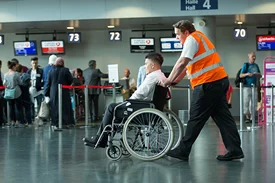
What assistance you can get
- Help from the airport entrance, the parking area or the train station to the check-in counter.
- Wheelchair and escort through security, passport control and to the gate.
- Priority boarding, help to reach your seat and to store your hand luggage.
- Help on arrival, through connections, at baggage claim and to the exit.
- Carriage of your wheelchair or other mobility equipment, usually free of charge.
- Assistance for passengers who are blind, deaf, or have cognitive or invisible disabilities, not only for wheelchair users.
How to request it
- Book the assistance at least 48 hours before departure, when you buy the ticket or later, through the airline or the agency. Mention every flight, including connections and the return.
- Say exactly what you need: if you can walk short distances or climb stairs, if you travel with your own wheelchair (type, size, weight and battery), if you need help in the cabin.
- On the day, go to the airport's assistance point or the check-in counter at the time the airline gives you. Allow extra time.
- For connections, leave a margin: assistance between flights takes longer than walking on your own.
Your rights by region
- European Union and United Kingdom (Regulation 1107/2006): assistance is free at airports and on board. Ask for it at least 48 hours in advance. Airlines may not refuse a booking because of a disability, except for justified safety reasons, and must carry up to two pieces of mobility equipment free of charge.
- United States (Air Carrier Access Act): airlines may not charge for assistance or refuse to carry you because of a disability. Wheelchairs and assistive devices travel free and do not count as baggage. On domestic flights, the airline must pay the full repair or replacement cost of a damaged wheelchair. Each airline has a Complaints Resolution Official (CRO) who must be available at the airport.
- Canada: large Canadian airlines must offer free assistance and, on domestic flights, an extra seat at no cost for a support person or for passengers who need more space ("one person, one fare").
- Other countries: most have similar rules. If the airline does not help you, contact the national civil aviation authority.
Electric wheelchairs and lithium batteries
- Tell the airline the type of battery and its capacity in watt-hours (Wh) when you book.
- If the lithium battery is removable, it must be taken out and carried in the cabin. It can be up to 300 Wh (or two batteries of up to 160 Wh each).
- You can carry one spare battery of up to 300 Wh, or two of up to 160 Wh each, in the cabin.
- Bring the user manual and, if possible, a label with instructions to disconnect or fold the chair.
- Take photos of the chair before you hand it over, and check it at the aircraft door on arrival. Report any damage before leaving the airport.
Invisible disabilities
Many airports use the Hidden Disabilities Sunflower lanyard. Wearing it tells staff you may need more time, patience or help, without having to explain why. Airports often offer free lanyards at the information desk, plus quiet rooms and maps for autistic passengers. Check the airport's website before you travel.
Service animals
- Trained assistance dogs travel free in the cabin on most airlines. Ask the airline in advance and carry the required documents.
- In the United States, only trained dogs count as service animals; emotional support animals are treated as pets.
- Check the animal entry rules of your destination country: some require vaccinations, a microchip or quarantine.
Children traveling alone (unaccompanied minors)
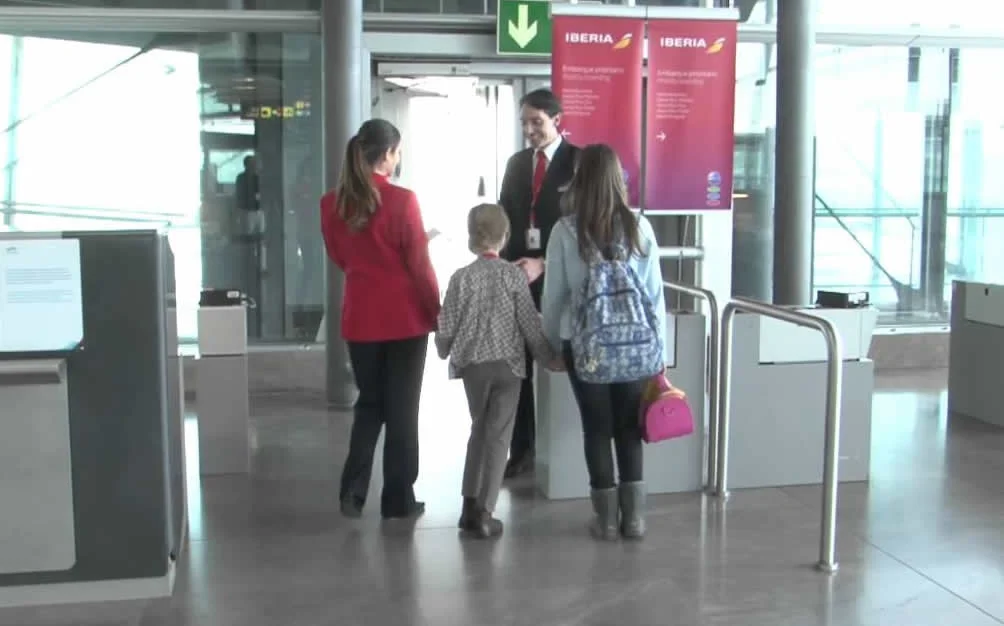
Rules depend on each airline. As a reference:
| Age | Most airlines |
|---|---|
| Under 5 | Cannot travel alone. |
| 5 to 11 (up to 14 on many US airlines) | The unaccompanied minor service is mandatory and has a fee. |
| 12 to 17 (15 to 17 on many US airlines) | Can travel alone; the service is optional. |
- Some low-cost airlines do not accept unaccompanied minors at all.
- Book the service in advance; it is often limited to direct flights or certain connections.
- The adult who drops off the child must stay until the plane takes off, and the adult who picks them up must show ID matching the name given at booking.
- Many countries require a notarized consent letter from the parents. See documentation and procedures.
Other passengers who need extra support
- Older travelers: anyone can ask for a wheelchair or assistance; you do not need a disability certificate.
- Pregnant travelers: airlines set limits by week of pregnancy. See medical recommendations.
- Passengers who need medical oxygen: only airline-approved portable oxygen concentrators can be used on board. Ask the airline well before the flight.
Official sources
- European Union – Rights of passengers with reduced mobility
- US Department of Transportation – Passengers with disabilities
- Canadian Transportation Agency – Accessible transportation
- Hidden Disabilities Sunflower
This guide is general information. Each airline sets its own procedures: confirm the details with your airline before you travel.